Art in the Garden
In partnership with Salford City Council and the Heritage Lottery Fund (HLF) a programme of community and public art schemes was developed as part of the major project to develop and conserve Ordsall Hall.
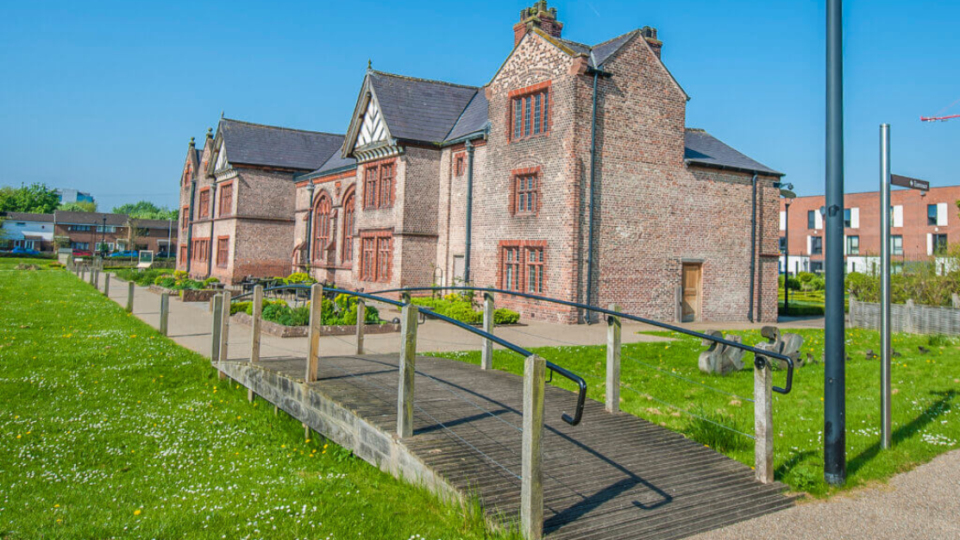
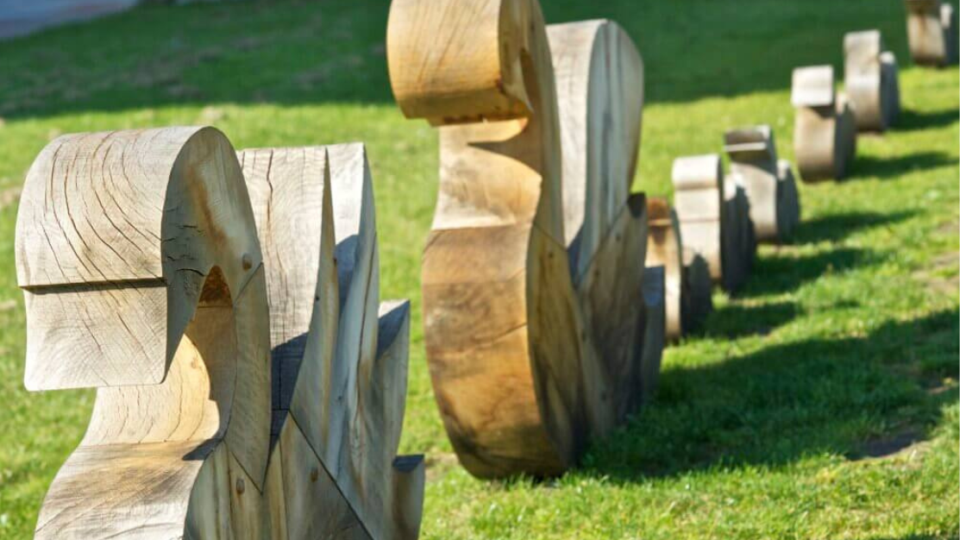
'Moat' by John Kennedy of Landlab
’Moat’, by John Kennedy, is an interpretation of the 14th century moat that once existed here. The subtle changes in the landscape create a memory of the moat’s original location. Its bridges offer the perfect view of the moat’s outline and his two art pieces ‘Causeway Edge’ and ‘Swans’. ‘Causeway Edge’ is a red sandstone monument to mark the position of the moat’s causeway. It is carved with ‘Reflections’, a line of text by poet Alec Finlay to mark an imaginary waterline. ‘Swans’ is a life size family of swans made up of a cob (male), pen (female) and cygnets, sited as if swimming in the Moat. They are made from untreated green oak slabs using traditional joinery techniques.
'Timeline' by Lesley Fallais
The art work ‘Timeline’, by Lesley Fallais, is woven into the Time Garden and aims to intrigue visitors and inspire curiosity. The work consists of key events, memories and artefacts that provide tantalising clues to some of the many fascinating and unique stories Ordsall Hall can tell. Chronological dates which highlight key events in the development and history of the Hall and its surrounding community, and personal memories of those who have lived at the Hall are carved into paving, bordered by tactile carved stone seats, inspired by patterns and motifs found inside the Hall, linking the interior and exterior. The poetic language of architecture has been carved into stone plinths around raised planting. Eight resin bronze objects that make reference to people who have lived, worked and played at the Hall are placed within the Time Garden, and the planting has been designed to highlight the passing seasons, moving from the bright pastels of Spring in the East to the rich hues of Winter in the West.
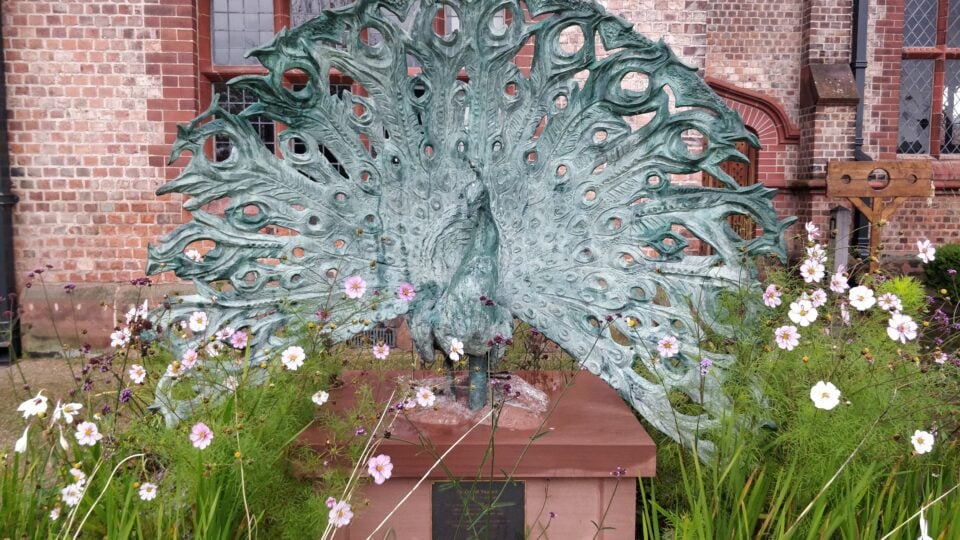
‘Peacock’ by Gertrude Hermes
This magnificent peacock is the work of artist Gertrude Anna Bertha Hermes (18 August 1901 – 9 May 1983) Hermes was a member of the English Wood Engraving Society (1925–31) and exhibited with the Society of Wood Engravers, the Royal Academy and The London Group during the 1930s. Her work has been exhibited at the Hepworth, The Whitechapel Art Gallery, The Tate, The Royal Academy, and The National Portrait Gallery and she was awarded an OBE in 1981. She produced a number of sculptures of people and animals, including swan sculptures for Ashburton Housing Estate in London and the Ordsall Peacock. David Bowie was an admirer and collector of her work, buying a 1926 bronze swallow door knocker by Hermes at a Christie’s auction in 1994.
The 1.63m x 2.11m bird was made by Hermes in 1961, as a commission to grace the entrance to Ordsall High School, formerly Ordsall Girls school between 1961-1988. After the school shut, the peacock disappeared and it was assumed it had been stolen for scrap. After going ‘missing’ for 24 years, and then spending another decade in storage the stunning artwork is now on permanent display in the grounds of Ordsall Hall.
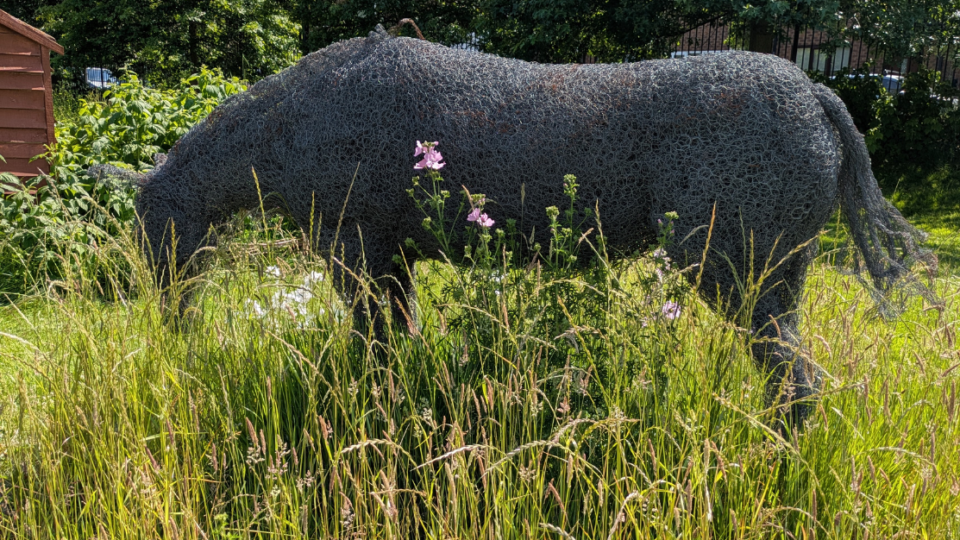
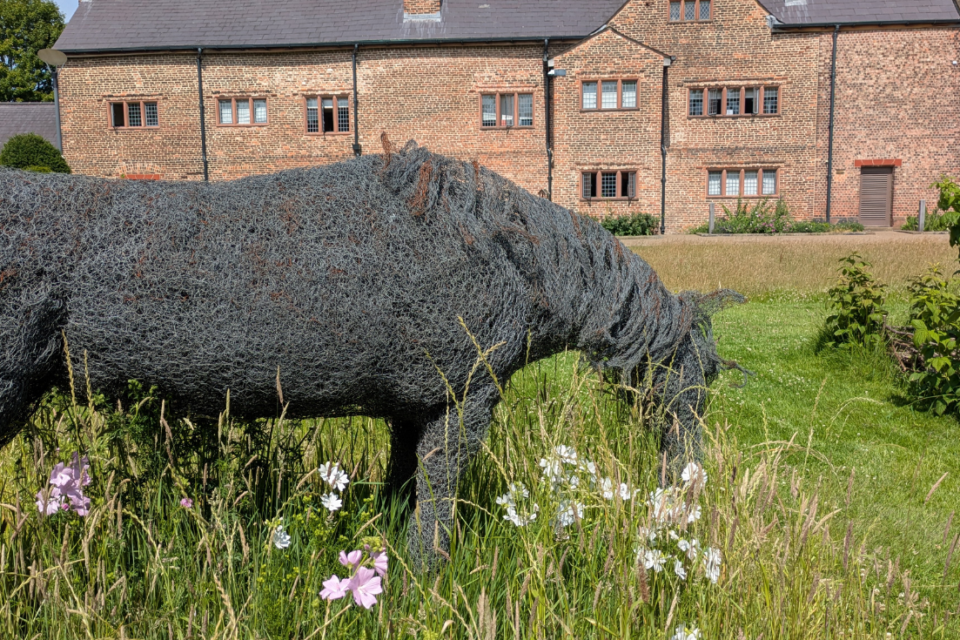
The Day's End, Steel and Wire by Angela Sidwell
In the summer of 2015 two artists took over Ordsall Hall for the temporary exhibition ‘Messengers and Promises’. The exhibition was based around the human relationship with animals and included drawings and paintings by Kate Herbert and sculptures by Angela Sidwell, a sculptor from Cheshire working predominantly in wood, wire and textiles.
One of Sidwell’s artworks ‘The Day’s End, Steel and Wire’ remains in the gardens. She has been working and exhibiting as an artist for the last fifteen years including creating large scale public art features, working in schools as a 3D specialist and exhibiting in galleries and outdoor sculpture events. Animals and the issues that surround them have always been pivotal factor in her work.
“It felt right to make a full size working horse that would sit amongst the surroundings at Ordsall Hall, conjuring up images of the past when there would have been a working farm here. There were several paintings of horses that I looked at in Salford’s collection, but it was Preparing for Market by John Frederick Herring, that I drew most inspiration from. I really liked the horse’s restful posture, before his long day at work, and imagined him later resting at the end of the day. For the actual body shape of the horse I looked to one of my horses – Poppy – who although not particularly tall is built like a tank. I can really imagine her in a time when horses were vital to man’s work, whether on a farm pulling carts, or “down pit” using her stamina and strength to earn her keep.”